Renato Ratti and Barolo’s new pack of winemakers
When Renato Ratti entered the Piemonte wine scene, by his own characterization, he did so as something of an outsider.
Ratti was born in 1934 in the flatlands near Cuneo. His father was a veterinarian of large animals.
Rather than follow the family line, Ratti went on to study enology in Alba, the heart of Piemonte’s Langhe region where the wines Barolo and Barbaresco reign supreme.
Ratti received his professional start abroad. He moved to Brazil and was placed in charge of vermouth and sparkling wine production out of São Paulo for the global brand Cinzano, based in Turin.
After his stint in Brazil, Ratti spent time in France before returning to Piemonte in 1965. He promptly bought his first vineyard, a small plot in the historical zone of Marcenasco at La Morra.
His writings reveal a determination to do things differently:
“I came to the world of winemaking without a family tradition behind me. I believe that this opening admission is necessary, for being free of any ancestral ties or responsibilities, I was able to face Barolo with neither pride nor prejudices, but with unfettered freedom.”
If Ratti’s goal, as described in other pieces of his writing, was “to set a new course” with his first vinification, his timing was impeccable.
A period of change was underfoot for a region characterized for its firmly rooted sense of history and tradition.
Ratti, who teamed with his nephew Massimo Martinelli, also an enologist, in 1969, became part of a new guard of winemakers looking to shake off some of the dust collecting on Barolo and Barbaresco.
Named for the neighboring villages nestled 12 miles apart in the Langhe hills, and made from the nebbiolo grape, Barolo and Barbaresco wines had more than a century of pedigree and prestige encrusted to their traditions by the time Ratti began making wines in the 1960s.
Controversial techniques developed by the likes of Ratti included efforts to shorten fermentation to limit the amount of time the wine spent steeping with the grape skins. Ratti and Martinelli also worked to reduce barrel aging to two years.
These practices made the most of new technology, such as temperature controls that made it easier to regulate fermentation.
The goal – and result – of these changes was to allow nebbiolo to showcase its rich notes of licorice, chocolate, leather, violets, and prunes while taming the highly tannic varietal so that the wine retained freshness and could be opened earlier.
A move to make Barolo and Barbaresco more approachable as younger wines fit with the evolving taste preferences of the day, but the divergence from the wines’ classic style caused a stir among producers and aficionados.
In The Wine Atlas of Italy and Traveller’s Guide to the Vineyards, Burton Anderson describes the break into two camps as between progressives and conservatives.
Progressives like Ratti and his nephew, as well as fellow members of the emerging class such as brothers Marcello and Bruno Ceretto with Barolo and Angelo Gaja with Barbaresco, would eventually carry the day.
The makeover they gave to Barolo and Barbaresco, supported by a string of charmed vintages in the 1980s, ultimately renewed interest and restored acclaim for Piemonte’s star wines.
Ratti passed away in 1988, at the age of 54, leaving his time of influence relatively brief, but the lasting effects of his philosophy on the region can still be felt today.
Beyond his contributions to shift winemaking approaches, Ratti’s imprint extends into the very core of how Piemonte producers find expression from the land.
French Connection
With his return to Piemonte in 1965, Ratti was hot on the heels of Italy’s nascent DOC (Denominazione di Origine Controllata) system that would identify specific delineated areas within the country permitted to use the geographic name on the label.
The model was based on the French AOC (Appellation d’Origine Contrôlée) and took effect in 1963. Similar classifications govern most wine production in European countries. The idea is to protect the tradition and prestige of historic zones.
As president of the Barolo Consortium, and subsequently general director of the Asti Consortium, Ratti took a lead role in drafting the regulations that would guide production in Alba.
He was particularly involved in rules that would govern the highest designation, DOCG (Denominazione di Origine Controllata Garantita), which emerged in 1984.
In addition to this regulatory work for the region, Ratti found innovative ways to connect his wines with the heritage of the land.
One line of Ratti labels feature a single soldier dressed in Napoleonic garb. The local regimentals was a way of geographically identifying the home of the grapes used for the wine.
A similar marketing spin was used by Livio Felluga in the northeastern corner of Italy in Friuli. Felluga used antique maps, first appearing on bottles in 1956, to show his vineyards located in Rosazzo of the Colli Orientali.
Ratti’s keen sense of wine telling the story of a place guided his pioneering effort to pursue single-vineyard wine production.
A highly studious viticulturalist, Ratti’s personal research included mapping the major vineyards in both Barolo and Barbaresco. He even went so far as to designate “first category” and “historical location” within Barolo.
“He introduced to the region the concept of single vineyard,” said his son Pietro Ratti.
Pietro took up leading the winery at the age of 20 following Ratti’s passing.
As Pietro noted, all cellars can be the same. The difference in the wine comes from the vineyard.
Within the Ratti renovated cellar, which Pietro undertook in 2002, an exposed floor-to-ceiling wall demonstrates the shared family appreciation for the nuanced gifts of the earth.
The wall not only displays the soil composition with all the elegance of an art gallery showcase but serves the functional purpose on controlling the level of humidity in the room.
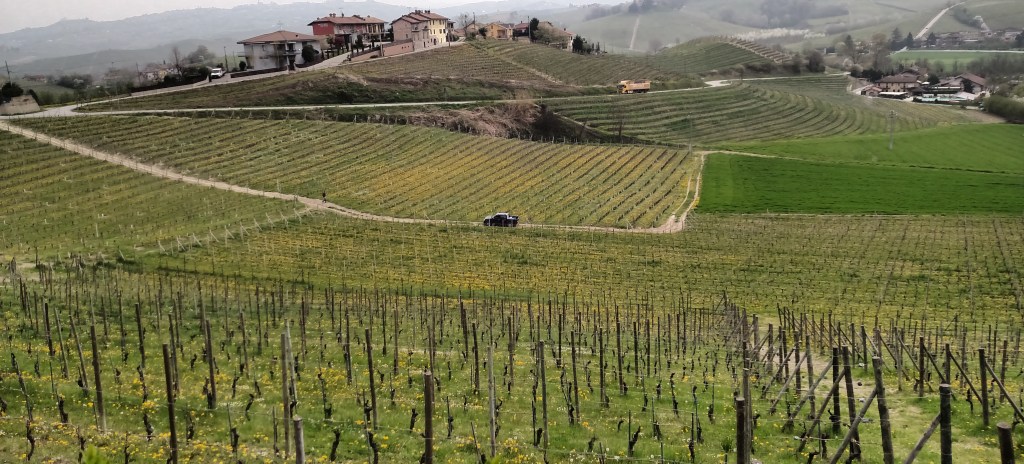
As part of a tour, Pietro points to the nearby hill as cultivated for Ratti wines and notes how, like Burgundy, the wines are made from selected grapes from scattered plots rather than harvested vines from a surrounding estate.
The comparison between Piemonte and Burgundy is a popular one.
As Karen MacNeil sums it up in The Wine Bible (2001), the two regions are “enological soul mates.”
One way they are joined is through the choice to concentrate on single-varietal wine production over blends and their devotion to highly sensitive grapes to get the job done.
Where Piemonte is best known for the caretaking of the temperamental nebbiolo, Burgundy is esteemed for the patient tending of delicate pinot noir.
The deeper connection often cited between the two is their shared dedication to terroir, an underlying current for most wine producers, but one particularly nurtured in Burgundy and Piemonte by their similar Benedictine backgrounds.
The Root of Terroir
Burgundy is often credited as the home for terroir, that that elusive French concept of wine as an expression of the sum of all the parts of its vineyard. It’s that certain je ne sais quoi that says the wine comes from a particular place.
Within Burgundy, the terroir born of Benedictine tradition was due in large part to the monks belonging to the Church and therefore members of a rare medieval class that was both landholder and literate.
Lands amassed by the Benedictines were gifts of the nobility, who bestowed the properties out of piety or in return for absolution.
With the call to carefully structure each day around prayer, manual labor, and study as the core tenant of the order’s founding Benedictine Rule, the monks were uniquely suited to both tend to vineyards belonging to their monasteries and meticulously record over detail.
The wealth and predominance of the Benedictines grew in lockstep with Burgundy, which covered parts of northern France, Belgium, and the Netherlands. The Abby of Cluny, the largest cathedral in Europe before St. Peter’s was built in Rome, became the Benedectine’s power symbol.
Lands owned by the Church were eventually segmented following the French Revolution and sold off as smaller pieces.
These properties were further subdivided by the Napoleonic Code, which instituted laws of equal inheritance.
For Burgundy’s vineyards, the splicing of estates created parcels that had become too small to reap enough of a harvest to make independently bottling, labeling, and marketing wines financially viable.
Enter the négociant. Négociants bought small lots of wine from growers to bottle and label under their own names.
Selection of grapes purchased by the négociants created a new system for classifying Burgundy’s vineyards by conferring top dollar for harvests from the most prized sites.
This work of the market’s free hand buttressed the region’s historical sense for terroir and conviction that variations can exist not just vineyard to vineyard but within a single vineyard.
It was the Benedictines and Cistercians, a stricter order that broke from the Benedictines, who centuries earlier had identified three levels of quality within the vineyard Clos de Vougeot – and determined who got to drink them.
Wines made from the lower part of the slope were cuvées de moines (wines for the monks), those made from the middle were cuvées des rois (wines for the kings), and, finally, those from the top were cuvées des papes (wines for the popes).
The combination of Benedictine legacy and négociant buying power eventually came together to formally codify Burgundy’s vineyards.
In 1861, Burgundy introduced its cru classification system, with cru literally translating to “growth” and typically referring to a specific vineyard or estate.
Today there are 33 Grand Crus, the most prestigious designation and approximately 2 percent of total regional production. The next-highest ranking is Premier Cru, or First Growth, representing about 12 percent of production.
Burgundy’s cru system is known as the most fastidious classification within wine-producing regions. Who but the makers of Burgundy’s enological soulmate to try to replicate it?
From Cru to Sorì
With champions like Ratti, Piemonte began its work toward vineyard categorization and a hierarchy between top sites.
Piemonte, in a historical parallel to Burgundy, had also grown its wine production out of a merchant-based system.
Similar equal inheritances laws as those of the Napoleonic Code likewise created a landscape where small growers sold their harvests.
Where négociants remained the primary operators in Burgundy for roughly two centuries, until growers started bottling their own wines in the 1960s and 70s, the same modern period marked a shift for Piemonte.
In The Wine Atlas of Italy and Traveller’s Guide to the Vineyards, Anderson notes how the emphasis on single-vineyard bottlings, led by the likes of Ratti, had increased land values and wine prices that provided growers enough capital to start producing and marketing their own wines.
As Pietro characterizes it, the 1960s and 70s of his father’s era focused on improving quality. The 1990s marked the period when growers started becoming producers, and vice versa. Already a producer when he took the helm, Pietro became a grower as well.
Anderson published his atlas in 1990, making him something of an on-the-ground reporter to the changes in Piemonte taking effect between the generations of Ratti father and son.
Anderson describes some of the challenges facing Barolo and Barbaresco winemakers in implementing a vineyard classification system.
Terms like sorì and bricco, broadly meaning “sunny” and “hillcrest,” or more specifically the south-facing part of a slope where winter snow melts first or the sun-catching crest of a hill, in local dialect, became popular in place of the use of France’s “cru” to indicate wine produced from a single vineyard.
However, Anderson argues that the prices of these types of single-vineyard bottlings were still to recent to be a reliable source as the basis for formal categorization.
Burgundy, after all, had roughly a century’s worth of market prices set by its négociants to draw from in determining its cru designations.
Without a market record as reference, Anderson observes, the question of hierarchy between vineyards largely becomes a matter of personal opinion.
What’s more, classification efforts were taking place alongside the modernization of cellars and new techniques that were revolutionizing and revitalizing the revered taste for Barolo and Barbaresco.
New style preferences for these wines, Anderson cautions, meant the historically prime real estate may no longer host the growing conditions to help a rising class of progressive winemakers achieve their goals of balance and finesse.
Old-school Barolo and Barbaresco, which were higher alcohol and more about power, were made from harvests on the hillsides where the snow melted first and the grapes could bathe in plenty of sunshine to boost the sugar content that could be converted to alcohol during fermentation.
Producers seeking a slower, softer ripening process were shifting their attention to cooler positions that would allow the grapes to develop more fruit and aroma.
Anderson highlights how these sites were relatively untested terrain to evaluate thoroughly.
Perhaps the only given in a discussion over vineyard classification within Piemonte is that it’s a topic unlikely to be settled any time soon.
It’s in the region’s very name.
With Piemonte meaning “foot of the mountain,” a moniker that’s rather quaint for an area where less than 5 percent of vineyards is classified as flat, it’s a landscape of endless nooks and crannies.
All of those varying sun orientations and differences in soil composition leave plenty of open field for debate.
 Chasing Wine