Confessions of a Somm from the Whisky Trail
So, how are you going to make Scotch work for Chasing Wine?
It was a fair question.
The rolling glens and dales of the Scottish Highlands and peat bogs of Islay represented a different sort of assignment from my usual vineyard tromping.
Officially, I could say that a somm worth her chops knows more than the wine list and can cover everything from aperitifs to digestifs.
Unofficially, I was drawn to doing some tasting that would be a chance to get down with some Gaelic roots.
The family tree grows from Ireland, and, as I learned in the fish ‘n chips line on Skye, it’s “Gay-lik” to the Irish and “GAA-lik” to the Scots. But, hey, at the end of the day, we’re all Celtic.
Off the record, I knew I had homework to do. If properly quizzed, the depth of my whisky knowledge would reveal itself as embarrassingly shallow.
I had no real bearings around what sort of flavors or styles I preferred. I just knew I liked the stuff. My understanding of the alchemy from barley seed to single malt also remained more of a grind toward textbook memorization than true comprehension.
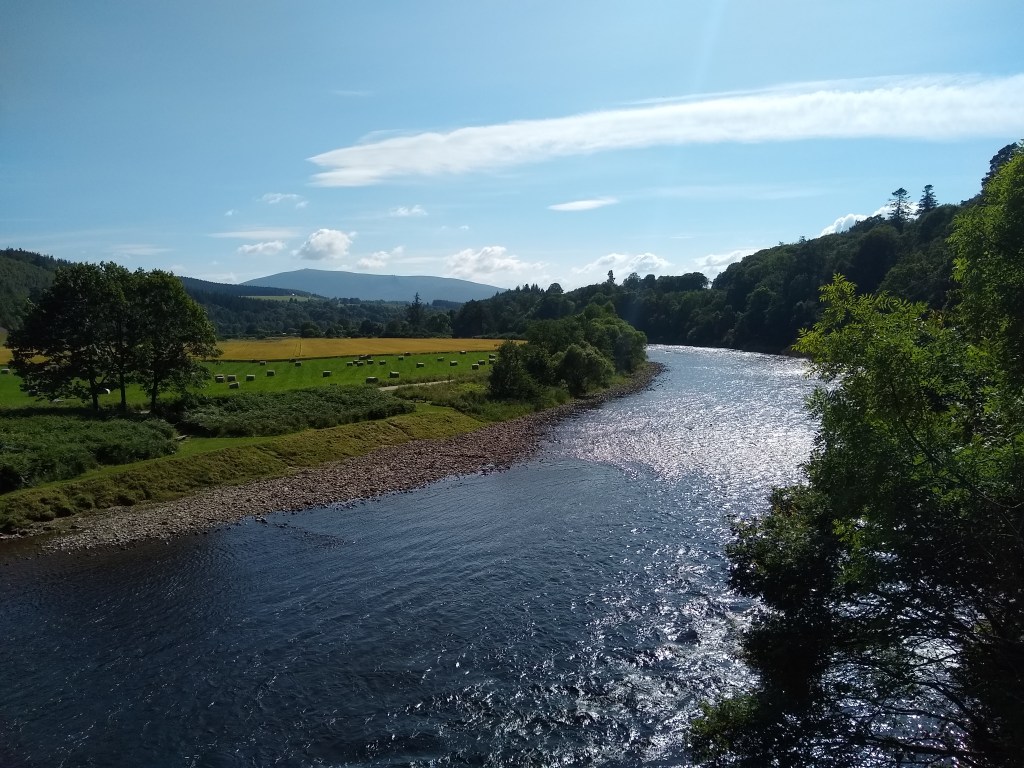
So, to Scotland, which held the image of being whisky’s mother country.
I may have gone full of the sense of finding all the national romance of a Robert Burns poem in each dram. What I came back with was a much richer story.
Here are my confessions of what I really learned about Scotch from three weeks as a somm on the whisky the trail
1. Scotch Is International
Writing in the Malt Whisky Yearbook: 2014, Charles MacLean describes the 1860s as the beginning of Scotch establishing an export market. In England.
By the 1880s, a few young gents with legacy names like Walker, Dewar, and Bell were charged with expanding their family brands abroad. The industry was eyeing the opportunities being created by an expanding British Empire that was sending emigrants, imperial envoys, and military officials to such far-flung outposts as Hong Kong, southern Africa, and Australia.
An empire without a setting sun was, in MacLean’s words, “the single largest trading unit the world had ever seen.”
The market race was on to become the brand that could provide a taste of home. Advertising budgets and company titles such as “Foreign and Colonial Traveller” followed to buoy the expansion efforts.
It’s roughly 160 years later, and while the advertising budgets are certainly heftier, the number of bottles exported (1.28 billion in 2018) could sink a Royal Navy fleet, and markets are no longer beholden to British emigrants, the narrative of Scotch’s worldwide appeal is more or less consistent.
In 2017, Scotch represented more than 20 percent of all food and drink exports from the UK. Who’s enjoying the most Scotch can vary depending whether we measure by volume (France) or value (US).
Even more than the overseas taste for Scotch, what I found truly international about Scotland’s tipple was how it’s made.
Scotch on a label indicates that the whisky matured for a minimum of three years in a warehouse in Scotland.
Warehouse location is mostly a matter of climate, and climate primarily affects how quickly whisky ages. The stable, relatively cool temperatures of Scotland keeps the evaporation rate of alcohol out of the cask around 3 percent.
Warmer areas like Kentucky have evaporation rates of 8 percent. The higher temperature also expands the wood staves, allowing the whisky to steep deeper, soak in the flavors, and mature faster.
These flavors picked up by the whisky from the casks, by the estimation of the Scotch Whisky Association, account for upwards of 70 percent of a whisky’s flavor profile.
Traditionally, it was casks used for shipping Sherry, Spain’s signature fortified wine, that were used for maturing Scotch.
In the 18th century, Sherry had become a fashionable drink in Scotland, and barrels of it were coming through the port cities of Glasgow and Leith.
After bottling the Sherry from its shipping containers, the casks were repurposed for maturing whisky.
This nifty bit of upcyling helped solve a natural shortage from the lack of domestic forests that could be felled for cask production.
What started as a matter of practicality developed into a preference for taste.
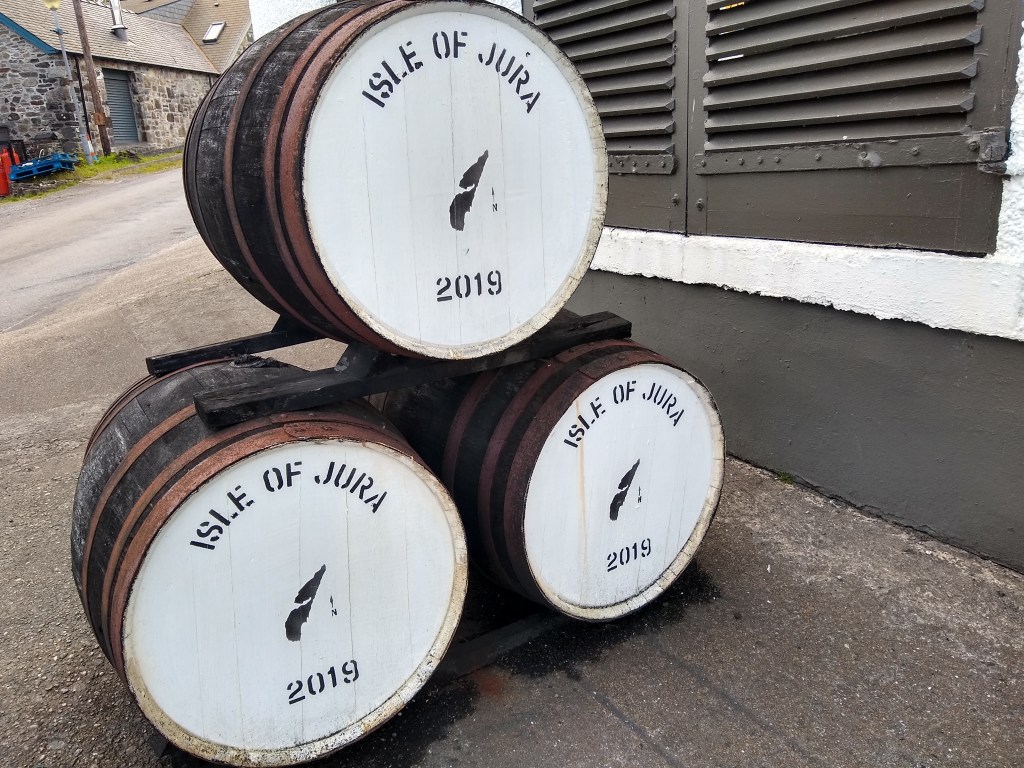
Though other wine and rum casks were reused in the same way, the ex-Sherry casks became the most prized, offering dried fruit and nutty components to whisky.
Since its 18th-century heyday, Sherry has posed something of a challenge in meeting the supply demands of Scotch distillers.
Sherry production started to decline in the mid- to late-19th century, just as Scotch was ramping up. In 1986, a change in Spanish law required all Sherry bottles to be filled in their homeland of Jerez before shipment. This meant that the supply of Sherry casks that once flowed through Scotland’s docks was officially cut off.
Distilleries reacted by washing casks with Sherry to imbue the flavors into the oak before maturing their whisky.
They also got a little help from bourbon, Scotch’s American cousin.
U.S. law limits casks to a one-time use for bourbon, creating a comparatively cheaper and more reliable source than ex-Sherry casks.
In 2017, it was calculated that nine of 10 casks types used were former bourbon or Tennessee whisky casks.
Bourbon casks lend richer notes of coconut and chocolate.
While it might be tempting to classify bourbon as aged from American oak casks and Sherry as matured in European oak, the distinctions are not so cut and dry. Sherry producers have used American oak for the last two centuries.
Though seen less frequently, other cask types include Port and Madeira (Portugal), Sauternes (France) and other wines (hello, Napa).
An amendment to the Scotch Whisky Technical File was codified into to law in June 2019 and gave the blessing to a wider variety of permissible cask types.
It did so in a rather roundabout way, by specifying which casks were not to be used. Anything else, it seems, is fair game. There is now creative license to work with such cask types as those previously used for tequila and mezcal, Calvados, cachaça, shochu and baijiu.
I for one delighted in the notion of recalibrating my image of Scotch to be the spirit melting pot, melding in the flavors of an international spice rack while creating its own identify.
For a distinctly Scottish aspect, there is peat, that mud-like turf that is the stuff of partially decayed plant matter that forms at the painstaking pace of one millimeter per year as organic materials slowly compress and squish together in an airless environment.
As the work of time on a specific set of conditions in a particular place, peat is arguably the most terroir aspect of Scotch.
Peat logs, which look like long, dried bricks, were the one-time main fuel source to Scotland’s kilns for drying the malted barley seeds.
Flavors imparted by peat range from the earthier characteristics of the Highlands to the more floral elements of the Orkney Islands to the cult-like devotion to Islay’s phenol-forward notes. Phenol-forward being a more polite way of saying medicinal.
2. The Story of Scotch Begins in the Fertile Crescent
Scotch does not exist without two things: barley and distillation. We owe both to the area nicknamed the Fertile Crescent.
Today’s domesticated barley varieties likely derived from the wild and weedy Hordeum vulgare spontaneum.

A popular theory among anthropologists is that the people shed the hunter-gather life and started setting down roots in order to grow enough grain to make beer.
The conclusion is drawn from the stack of archeological evidence that shows barely as one of the earliest cereals to be farmed. It was harvested over wheat varietals that were also available and would have been much better suited to the purpose of making bread.
Barley, on the other hand, seems genetically inclined for making beer.
With an intact hull that protects the seed while germinating and tougher seed kernels than other cereals like wheat or rye, barley is better able to withstand the high moisture content associated with malting.
Malting is the process of soaking barley seeds in warm water, getting them to thinking that it’s spring so that they start to sprout. This playful trick on Mother Nature prompts germination, which releases enzymes that convert starches into sugar.
In all likelihood, the first form of malting started by accident in a porridge bowl.
Porridge, cooked from dampened, sprouted grain, would have become sweet once heated, as the enzymes activated and converted starches into sugar.
The sugar in the porridge would then have become available to yeasts naturally present in the air. Once yeasts started eating the sugar, fermentation would have begun.
Unlike wine, made from grapes that have sugar free-flowing within the juice of each berry to allow yeasts to feast and fermentation to take place, beer requires this extra step to get to the sugar that is stored inside the grain seeds and reserved as an energy source for growing leaves. Once the leaves are grown, photosynthesis can take over as the energy source.
People caught on that they could help shepherd this process. The first known recipe is for beer, scribed over 4,000 years ago as a hymn to the goddess of beer Ninkasi, worshipped by the Sumerians of Mesopotamia.
Just as civilizations across the world figured out alcoholic fermentation early in their histories, they also demonstrated a penchant for making their tipples more potent through distillation.
The Chinese were distilling rice beer by 800 BCE, and there are reports of distilled spirits from Britain before the Roman conquest. It’s likely that Spain, France, and the rest of western Europe were experimenting with distillation at an earlier date.
Distillation is the application of a heat source to an already fermented liquid (beer or wine). As the liquid boils, its alcohol will vaporize at a temperature of 176 degrees Fahrenheit but its water content won’t vaporize until a temperature of 212 degrees.
Rising as steam, the vaporized alcohol can be collected, cooled, and condensed back into liquid form.
We owe much of today’s science for distillation to the ancient study of alchemy, a discipline focused on understanding the nature of substances and the most basic elements of nature.
Alchemy included things like melting down such base metals as lead or copper to try to transform them into silver or gold and searching for cures for diseases. The creation of pure cold was considered a transmutation toward Heaven.
To spirits aficionados and trivia-lovers, two well-known alchemists are eighth-century Abu Musa Jabir ibn Hayyan and first-century Maria Hebraea (aka Maria the Jewess and Maria the Prophetess).
Abu Musa Jabir ibn Hayyan is credited with inventing the alembic, from the Arabic al-imbiq, still, which has evolved into the pot still.
Custom modifications may vary distillery to distillery, but the basics remain the same, and the pot still is used for making most whiskies.
The process through the pot still is gentler, retaining more of the flavors of the base fermented beverage, than the column still used for lighter, cleaner spirits such as gin and vodka.
Scant details are known about Maria Hebraea, but she is thought to have started an academy in Alexandria, where she taught alchemy. Her contraption for distillation is the basis for the bain-marie, or double boiler, found in kitchens the world over and a central piece of modern chemical equipment.
These sort of scientific forays into alchemy evolved into the practice we know as distillation. One theory for how knowledge about distillation reached Scotland and Ireland is based on the availability and translation of Arabic medical texts.
The late English whisky writer Michael Jackson in Whiskey: The definitive world guide, attributes a family of physicians named the MacVeys (also known as Beatons) as being the good docs to carry out the translation and help spread the word.
The first documented reference for whisky in Scotland appears in the 1494 Exchequer Rolls, the tax records of the day, and is owed to the Church.
An entry lists: “Eight bolls of malt to Friar John Cor wherewith to make aqua vitae.” For those keeping score at home, that’s enough malt to make 1,500 bottles of spirit.
Aqua vitae, being Latin for “water of life,” is the original root for whisky, itself a derivation of the Gaelic uisge beatha as a translation for the Latin.
3. Everything You Wanted to Know about Distillation (but were afraid to ask)
From malt, mill, mash to still, the art of whisky making is a series of carefully shepherded chemical reactions.
The process also comes with its own set of vocabulary that adds a layer of nuance to the scientific fundamentals.
While I grasped what happened in each stage for making whisky, connecting the dots remained elusive. Here’s how I finally mastered it.
Today’s more finessed malting process is followed by grinding the dried barley seeds, now officially called malted barley, or simply malt, through a mill to create a coarse grist.
With grist, all the sugar that was released as part of malting is in a state where it now can be extracted.
Consistency of the grist has to strike the balance of splitting the grains without becoming as fine as flour, which would clog the machinery, or being too coarse, which would prevent the sugar from being extracted.
The makeup for grist is roughly 70 percent larger particles called grits, 20 percent husks, and 10 percent flour.
Grist is poured into a large vat called a mash tun and mixed with hot water to dissolve the sugar. The resulting sugary liquid has the uniquely unappetizing name of wort.
This process for creating wort is called mashing and is followed by fermentation.
Wort is drained from the remaining solids of the grist, cooled, and poured into large vessels called wash backs. Yeasts are added to prompt fermentation.
After fermentation, beer has been made. Distillers refer to their fermented base liquid not as beer but as “wash.”
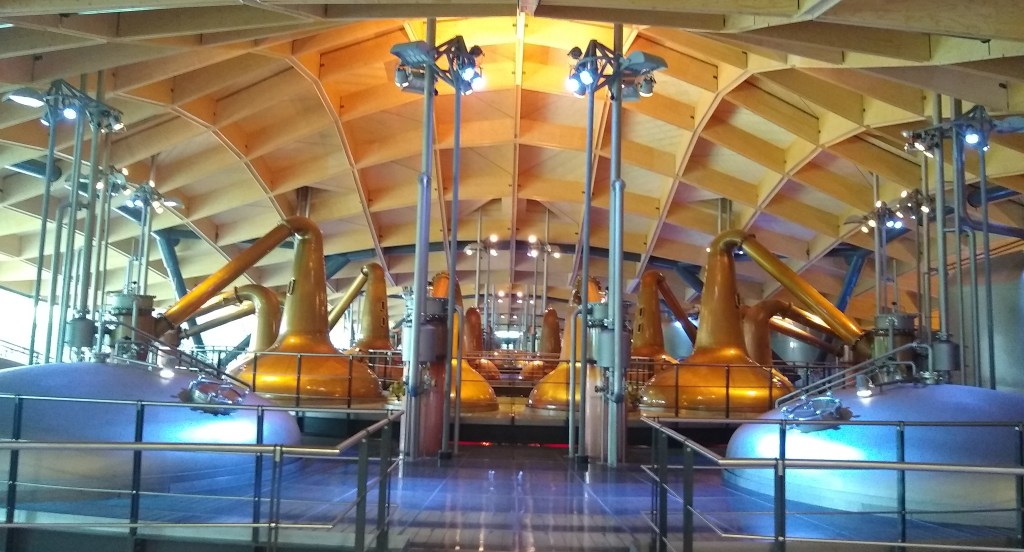
With the wash, the whisky trail continues with two rounds of distillations. First up is the wash still.
In a somewhat odd turn of phrase, what is gathered from the wash still for further distillation is called “low wines.”
The resulting low wines are about 23 percent alcohol-by-volume before going into the spirit still.
What first comes out of the spirit still is called the foreshots (also simply known as fores or “heads”).
It is the judgement of the distiller to decide when the first fraction of foreshots have all been collected and the still run is into the desired center cut, or “heart.”
Along with the alcohol, congeners – compounds such as esters, tannins, methanol, and fusel alcohols – also evaporate that affect the flavor. Distilling is balancing the amount of alcohol with the desired congeners for flavor.
“Tails” make up the end of the run, with feints being a combo of heads and tails.
While the heart will go on directly to the casks for maturation, the feints will be combined with the next batch of low wines to come from the wash still for another go through the spirit still.
As descriptions go, it may not have the reverence of a recipe-hymn to Ninkasi, or the eloquence of a Burns poem, but there it is.
 Chasing Wine