On the western front with Ščurek
It started with a single hectare.
The family records for Ščurek winery show that the grandfather of founder Stojan cultivated one hectare of vines, producing 50 hectoliters of wine, a slice alongside broader agricultural efforts.
In 1989, the first bottling under the Ščurek label took place with Stojan pooling resources and machinery alongside other producers. Located in Medana, a small village in the wine region of Brda, Ščurek sits on the far western frontier of Slovenia,
The bottling came two years before Slovenia would become the first country to declare independence and separate from the former Yugoslavia. At that time, private landholdings were limited to 10 hectares (25 acres).
Today, Ščurek, which continues as a family enterprise supported by the five sons representing the fourth generation, cultivates 20 hectares and approximately 100,000 vines.
“When it’s a family business, you have to work,” said Nate, the youngest of the sons, serving as guide through the winery.
Nate is considered to still be learning the craft and studying while his older brothers all have active roles. It’s Tomaz who has stepped into the part of winemaker, producing his first wines at 15 and apprenticing under their father before assuming the full-time title in his early 20s.
Production at Ščurek for the most part mirrors that of the rest of Brda, with 65 percent as white wines, including both local and international varietals and blends.
There is Kontra, a 50-50 chardonnay and rebula (ribolla gialla across the border in Italy), unfiltered wine that is bottled after the grapes have macerated for 10 months in 300-liter oak barrels without added sulfites or preservatives.
Stara Brajda Belo (Old Vineyard White) is a blend led by 60 percent rebula, 20 percent pikolit, 20 percent pika, and a touch of glera, tržarka, and malvasia.
On reds, production is primarily merlot, with cabernet sauvignon, cabernet franc, and pinot noir rounding out the list. Both the Bordeaux family and pinot noir are representative of popular red varietals that express themselves well in Brda.
A sort of playfulness underlies the spirit of Ščurek wines, beginning with the name. Ščurek translates to cricket – or cockroach – and the label shows a cricket playing the violin.
“The cricket sings. Not so good, but it’s okay,” Nate explained with a grin.
It’s that attitude to take the work, but not themselves, seriously that also reveals itself in the barrel room. Since the early 2000s, artists invited to stay at the winery have made canvases of the old casks, turning the cellar into a veritable gallery.
“To make good wine you have to be an artist,” said Nate of the pairing.
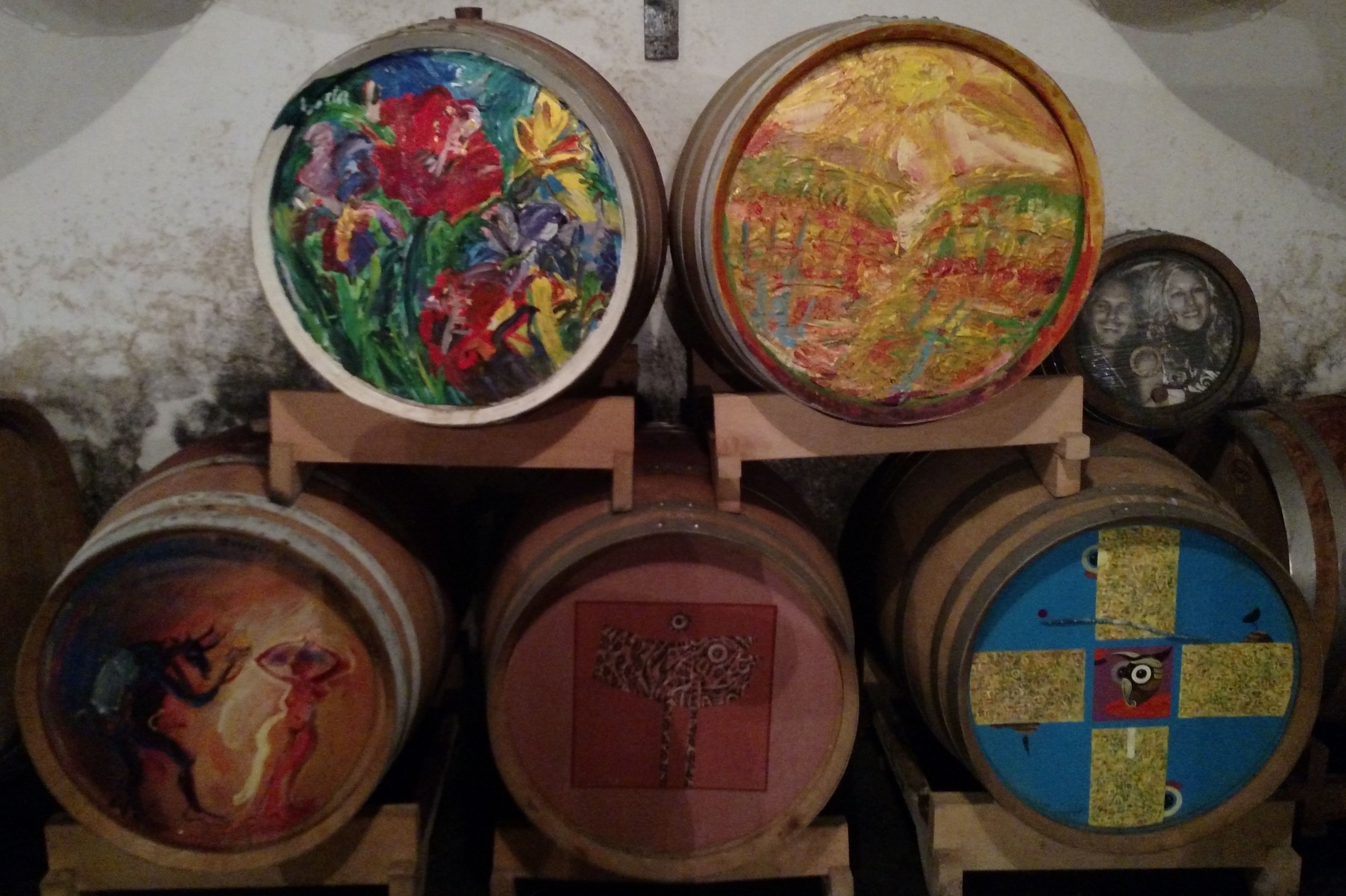
Other pieces, from paintings to sculptures, are staged throughout the winery, including the tasting room, which overlooks the rolling vineyards and the one-time border with Italy.
Before starting the tasting, Nate leaned out the window, pointing to a narrow winding road, and related a story from his grandfather.
As the grandfather told it, a neighboring farmer would casually take his cattle from one side of the road to the other, depending on which army happened to be travelling through. He would then be able to claim, in the herd’s defense, either “Slovenian cows” or “Italian cows” as would appease the passing troops.
The official demarcation line may have moved since the grandfather’s day, but the vines at least seem to feel the same easy border jumping as the old farmer with his cows.
Brda, with its topography and conditions, is considered such an extension of its wine-producing neighbor, Italy’s Collio in Friuli-Venezia Giulia, that Hugh Johnson and Jancis Robinson include Brda as part of their map for Collio (The World Atlas of Wine, 7th edition, 2013).
Slovenia’s Italian border to the west curves down to a stretch of coastline that rides the Gulf of Venice. A 416-mile border is shared with Croatia to the south, southeast, and east before turning upward along Hungary to the far northeast. Austria lies to the north. Overall, the outline looks something like an outstretched butterfly.
For most of history, Slovenia was ruled by the Habsburgs of Austria. It was the Austrian Archduke Johann who introduced chardonnay, sauvignon blanc, pinot gris, pinot blanc, traminer, muscat, riesling, and pinot noir to inland Slovenia in ordering, in 1823, that “all noble vine varieties that exist” be planted on his estate at Maribor.
Maribor sits on the Drava River and is modern Slovenia’s second-largest city after the capital Ljubljana and is roughly a two-hour drive from Brda.
Brda, full name Goriška Brda, is a small northern pocket of the larger wine region Primorska, characterized by its joint Adriatic and Alpine influences. Summers tend to be hot and autumn rains can arrive early.
In addition to Brda, Primorska consists of the Vipava Valley, home to a cooler climate, and Kras, a limestone plateau north of Trieste.
Slovenia’s other two wine regions include Podravje, the largest and most inland, reaching up toward Hungary, and Posavje to the southeast.
Though in the 21st century the country’s total area dedicated to vineyards has been declining, the wine industry as a whole is considered as becoming increasingly professional.
Slovenia may be a small player on the world wine stage, but it seems to have consistently found a way into recognition.
In the 1970s, the wine known as Lutomer Riesling, now renamed as Ljutomer Laški Rizling, from Podravje was one of the rare wines exported from Eastern Europe to the West. It often held a high dose of sugar and sulfites and was shipped in bulk to London in bottles made to order.
There is certainly more finesse to today’s scene. In the 21st century, let’s hope Slovenia continues to define and share its oenological style.
 Chasing Wine