Livio Felluga and restoration of vineyards to Friuli’s hillsides
In Italy’s far northeast crevice, sandwiched between the Alps to the north and plains leading to the Adriatic Sea to the south, is the tiny jigsaw puzzle of Friuli-Venezia Giulia.
Its soft rolling hills, colli in the local Friulian dialect, are home to the Colli Orientali del Friuli and Collio Goriziano wine regions.
More simply known as the Colli Orientali and Collio, these two neighbors preside as the standard-bearers for Friuli-Venezia Giulia, Italy’s premium white wine territory since the 1970s. Slovenia’s Primorska wine region lies just over the border.
The reputation for Friuli-Venezia Giulia, shorthand Friuli, extends to respect as a leader on an international scale. As Karen MacNeil put it in The Wine Bible (2001), describing Friuli’s roughly two-decade renaissance, “No other region of Italy has moved so quickly from near obscurity to distinction.”
The 1970s marked a global boon for the wine industry, and Friuli could be said to have benefited in part to renewed interest in the fruits of the grapevine. In the U.S. for instance, total wine consumption was on a steady upward tick, a trend that began in the late 1960s, and burgeoning regions like California would turn heads on the world stage with the 1976 Paris tasting.
For Friuli to be in the right place at the right time for this revolution required the foresight and dedication of producers like Livio Felluga, who recognized the earth’s gifts to the Colli Orientali and Collio.
The pair, indeed, seemed to be blessed with the natural attributes made for the vine.
Colli Orientali, whose name means “eastern hills,” sits, somewhat counterintuitively, slightly northwest to Collio. It’s protected from northern winds by the Julian Alps and is slightly cooler than the Collio, which lies closer to the Adriatic and receives more of the sea’s moderating influence over its climate.
There is little more than sporadic sign posts to indicate where the Colli Orientali, located in the Udine province ends, and the Collio, in the Gorizia province begins.
If the distinction between the two seems like splitting hairs, the vines always know where they are.
Both regions benefit from the tandem of mountain and sea working together to keep the days warm and nights cool, providing the diurnal shift that warm-climate grapevines love.
The fall in nighttime temperatures slows down the ripening process, allowing the grape bunches longer time on the vine to ripen to maturity and complexity. Stalling the ripening also helps preserve the balance between sugar, which becomes wine’s alcohol content, and acidity, which gives wine its zing.
In Friuli’s case, vineyards stretched on the hillsides and plains on the sunny side of the Alps are able to bathe in heat and sunlight throughout the day before their evening rest, leading to ripeness, fullness, and a strong backbone of acidity.
Trademark Friulian white wines show delicacy and grip, a precision point requiring exact timing on the harvest.
Local technique tends to steer clear of practices such as malolactic fermentation and wood, both of which would have a softening effect on the wine and obscure the focus that nature worked so hard to achieve.
Bold Moves
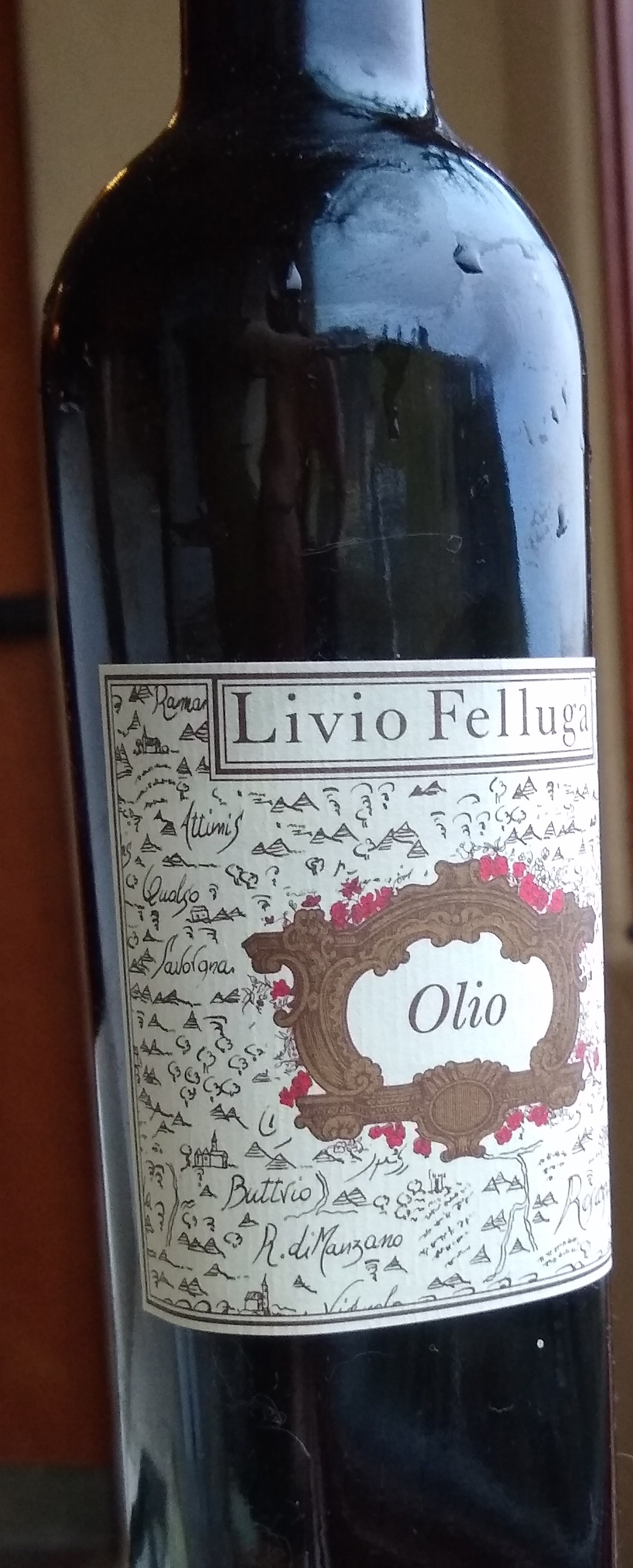
The historic map label of Livo Felluga debuted in 1956. In addition to wines, the estate produces olive oil.
Felluga first arrived on the scene in the late 1930s, moving to Collio after becoming enamored with the countryside and seeing the potential to make premium wine.
Born in Istria when it was still part of the Austro-Hungarian Empire, Felluga brought with him the know-how of three previous generations of agriculturalists.
Felluga’s great-grandfather was a farmer and his grandfather a vine grower. The family made refosco and malvasia form its vineyards and also ran a small trattoria at Isola d’Istria.
A young Felluga, who would become the eldest in a large family, assisted his father, who was charged with expanding the family’s wine trade and opened shop in nearby Gardo, a fashionable seaside resort.
Felluga’s own plans to venture out and begin winemaking in Collio were interrupted by World War II. Drafted in June 1940, Felluga fought three years in Libya and was held as a prisoner of war at Cap Bon.
In the 1950s, Felluga bought his first few hectares at Rosazzo, previously a subzone of the Colli Orientali and its own DOCG (Denominazione di Origine Controllata e Garantita) since 2011.
The Rosazzo DOCG requires a blend that is modeled off the Livio Felluga wine Terre Alte, which had its first vintage in 1981. Primarily friulano (50-60%), the Rosazzo DOCG includes sauvignon blanc (20-30%), chardonnay and/or pinot bianco, and ribolla gialla (maximum 10%).
Entering the wine business is a gutsy move at any time. Felluga and handful of pioneering peers decided to do it during a period of industrialization and modernization on land that had been abandoned during the war.
As post-war factories were built, people increasingly left the countryside and agriculture for the town and more reliable work.
To market his wine, Felluga designed a label from an antique map to show where the wine was made. In the northwest pocket of Italy, in Piemonte, Renato Ratti would do something similar, using the image of a Napoleonic soldier wearing the local regimentals of Alba.
Felluga’s label, first appearing in 1956, was both practical and a sort of love note to the area that had become his oenological home. His children, representing the fifth generation, continue the business. Felluga himself passed away in 2016 at the age of 102. (His longevity suggests he carried more secrets to life than just great winemaking.)
Part of the label’s brilliance is it predates the DOC (Denominazione di Origine Controllata), a labelling system developed by the Italian government and which took effect in 1963.
The DOC follows the template of France’s Appellation d’Origine Contrôlée (AOC), rolled out in the 1920s. It introduced the concept of creating delineated areas that were permitted to use the geographical name on the label.
Furthermore, for a wine to qualify for the appellation’s name, it had to adhere to other requirements as well, such as permitted grape varietal(s), maximum crop yield, minimum ripeness, and, to some extent, local techniques.
As a labelling system, the AOC, and others in Europe that have followed its template, prizes sense of place. It is intended to protect the prestige of the most coveted wine zones and preserve traditional practices.
One advantage of systems like the AOC is its ability to convey a lot of information in a limited amount of space.
For example, chenin blanc in the Loire Valley runs the gamut from bone dry to semi-sweet to full-on dessert wine. The appellation name from within the valley helps remove the guesswork.
Savennières on the label sets the expectation for dryness, whereas a wine from Quarts de Chaume indicates a higher level of sweetness.
In this way, the AOC acts as a sort of Good Housekeeping seal of approval, providing assurances around quality and setting a basic profile for how the wine should taste.
In the case of the DOC, it’s generally considered as lacking in specificity, with boundaries that are too broad and maximum yields that are too high, to achieve the same effectiveness of the AOC.
Attempts to rein in and tighten the DOC came in 1984, when Italy established the DOCG (Denominazione di Origine Controllata e Garantita), a designation to be reserved for its highest-quality wines – controlled and guaranteed. Six original DOCGs made the first cut.
The problem of the DOCG is it became a magnification of the soft spots in the initial DOC.
All of Chianti, for example, ranks as a DOCG. As does Chianti Classico, the area between Florence and Siena covering seven sub-zones and considered the oldest, truest representation of Chianti.
As of 2017, there were 74 DOCGs, rendering the system more political than practical.
Orderliness has never been the strong suit of Italian wines. Chalk it up to the embarrassment of riches. The Greeks, upon arriving in Italy, dubbed the country Enotria, “Land of the Vine.”
As a country, Italy can boast more than 1,300 registered varietals, including hundreds of indigenous varieties.
In Friuli’s case alone, there are approximately 30 grape varieties, both local and international varietals, that are commonly planted. It’s estimated that before phylloxera hit Friuli in the late 1800s, more than 350 varieties were grown.
As a region, Friuli maintains its premium status with roughly a third of its production meeting DOC standards.
While there’s strength in numbers, a simple map, the same as used more than 50 years ago, may be all it takes to speak to Friuli’s quality.
Above: The restored vineyards of l’Abbazia Rosazzo (monastery of the roses), a historical and cultural center of Friuli, have been entrusted to the Livio Felluga estate for caretaking. The specially created Abbazia Rosazzo 2009 is a blend of friuano, sauvignon blanc, pinot bianco, malvasia, and ribolla gialla as a tribute to Rosazzo’s terroir.
 Chasing Wine