Innovation is in the DNA of J. Hofstätter
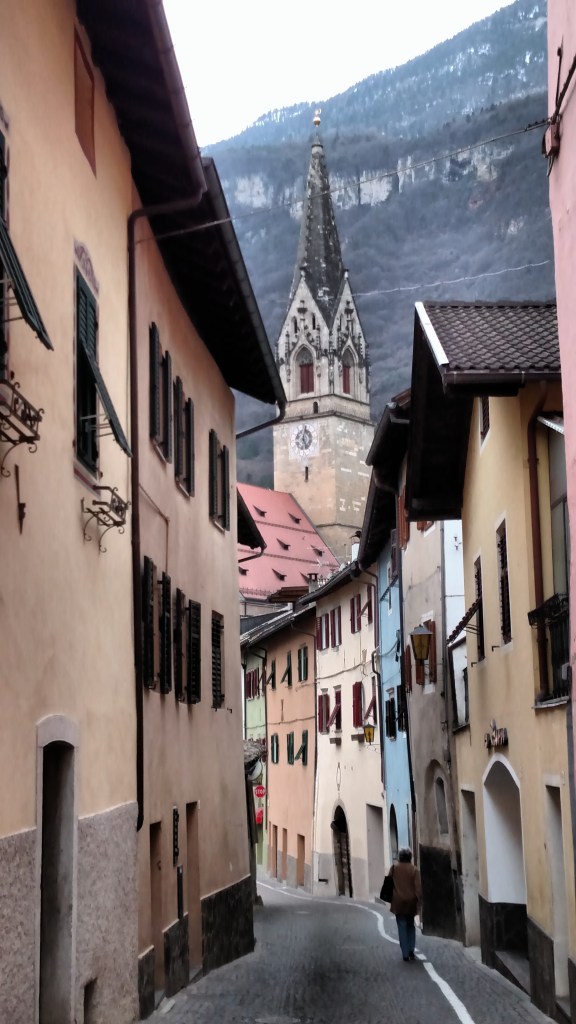
In the center of Tramin stands the town’s calling card.
The 86-meter bell tower for the Church of Saints Julitta and Quircus is the tallest steeple built out of stone in the South Tyrol.
Across the square from the tower, in stark contrast to the medieval atmosphere, is the sleek and modern tasting room of J. Hofstätter. Then again, innovation and forward-thinking have been a hallmark for J. Hofstätter, now with more than 100 years of family ownership, and part of the winery’s DNA since the beginning.
Headquarters for J. Hofstätter are in what was once the Imperial Royal post coach office, constructed in the 16th century and a nod to the South Tyrol’s almost 600 years as part of the Habsburg Empire. The original façade has been preserved.
The building was converted to the Schwarzer Adler inn, owned by the current generation’s great aunt, Maria Hofstätter. Maria’s husband, Josef, wore many hats in the family business as the inn’s blacksmith, host, and winemaker.
A boon for the Hofstätter’s inn was Tramin’s plans to expand its hallmark church, as workers for the construction became patrons in need of lodgings and meals. An enterprising Josef used the opportunity to start making more wine, expanding production beyond what was needed for the busy inn.
His move to increase quantity did not come with a sacrifice to quality. Instead, he chose to focus vinification on the fruit of individual vineyard parcels.
The tradition has been passed down through the four generations of family operation. Since 1987, J. Hofstätter has labelled its Pinot Noir Barthenau Vigna S. Urbano and the Pinot Blanc Barthenau Vigna s. Michele to indicate that the grapes came not only from a single vineyard, but a specific parcel within it.
Vigna is a designation equivalent to the French cru. J. Hofstätter became the first winery in the South Tyrol to include it on labels.
If the payoffs for such selectiveness are obvious – prime land and vineyard conditions yield prime fruit – so too are the perils. A low-production or otherwise poor harvest could mean skipping vinification of that vintage or using the grapes for a different wine.
Other quality-control measures embraced by J. Hofstätter include hand picking the grapes. This may be as much out of necessity as choice. The hilly hamlet, with vineyards stretching above the valley floor of apple orchards, would make running machinery through the rows of vines difficult.
At J. Hofstätter, the highest vineyard is at 800 meters and reserved for sauvignon blanc and pinot grigio. Every 100 meters creates a temperature difference of two degrees Celsius, noted assistant winemaker Markus Heinel.
Markus came to winemaking by way of playing hockey. It was during a team trip to South Africa, where a tasting convinced him to leave behind the ice rink for the wine cellar.
“It’s a beautiful job,” Markus said. “You really can create something.”
He exhibits the same spirit of experimentation as has defined J. Hofstätter the past century. Between harvest, vinification, aging, and bottling, it can be a long road between trying something new and deciding if it worked.
Sample bottles from vintages are kept on hand for taste tests. Innovation can take the form of keeping the leaves, avoiding a cutting that causes the vine to create new shoots that divert energy away from the grapes, or introducing specially designed concrete tanks.
With a flattened bottom and tapered top, the concrete tanks mimic a wine glass. The conical shape helps maximize the juice’s contact with the grape skins, extracting color and flavor. Openings on the top and bottom allow for pumping over and punching down for further maceration.
The balance of depth and delicacy in J. Hofstätter’s wines today is showcased in its work with lagrein, a local varietal that J. Hofstätter helped revive in the 1980s by cutting back on yields to improve concentration of flavor and start standalone vinification.
Previously used as a blending grape to add body to the region’s more traditional wine made from vernatsch, lagrein today is a varietal that allows Tramin to “set the bar,” said Markus.
Hofstätter’s lagrein plantings are on the Tramin side of its vineyards, catching the early morning sunlight and warmer temperatures. Tramin’s eponymous gewürztraminer is also planted on this side.
Lagrein may be the offspring of another rescued varietal, teroldego, whose home is the Campo Rotaliano, rare planes in this shared mountainous region of Trentino-Alto Adige.
Like lagrein, teroldego was recovered and rediscovered in the 1980s. This revolution followed a push to a more industrialized wine business that came in the wake of World War II and led to vines being replanted with clones that could offer hearty harvests.
One of the leaders in the charge to preserve historic clones was Elisabetta Foradori, who followed her mother into the role as head of the family vineyards and winery.
It seems fitting that J. Hofstätter and Foradori should share a stronger link than varietal lineage. These two regional figure-heads have been related since the 1940s, when Paolo Foradori married Sieglinde, the great-niece of Josef and Maria.
The couple is carrying on the work and tradition of the family business with the next generation already in the fold.
 Chasing Wine