Tasting with Weingut von Elzenbaum, one of Tramin’s oldest family-operated cellars
The Alpine hamlet of Tramin boasts a storybook setting for its tidy hillside vineyards.
Rows of vines climb above and overlook the valley floor of apple orchards. The narrow, steepled bell tower crowns it all in this South Tyrolean outpost in northern Italy.
Local legend supports Tramin’s claim as the home of gewürztraminer, which certainly carries the town’s name. The short version goes that the native traminer grape eventually picked up its German prefix gewürz, meaning “spiced,” as a way of characterizing the cinnamon, nutmeg, and clove notes of the aromatic wine.
Wine writer Jancis Robinson adds some nuance to the tale, noting that the original Traminer is green-berried and not particularly fragrant. It is thanks to a mutation of the grape, she argues, that the pink-berried, perfumed varietal known as gewürztraminer came along. The prefix, rather than being a gift bestowed to traminer, is instead a way of distinguishing between the two different grapes.
Most wine experts agree that gewürztraminer reaches its prime in France’s Alsace region, where it is one of the four noble varietals.
Still, a trek to Tramin is worthwhile, if not to explore the curiosity of how the distinctly German-sounding gewürztraminer could hail from this Alpine crevice of modern Italy, then to simply indulge in the charms of the idyllic surroundings.
Tramin, Italian name Termeno, sits on the Weinstraße, or wine route, a dotting of vineyards and cellars that hug the Brenner Pass. This opening in the Alps connects Austria and Italy. Low-altitude and travelable year-round, the pass has served as a sort of main highway since Roman times.
As the Weinstraße continues south from Tramin, crossing from Italy’s Alto Adige region into the country’s Trentino province, it picks up Italian signage, becoming the Strada di Vino.
Though a hyphen often adjoins them, Trentino and Alto Adige are two autonomous provinces, with the northern Alto Adige annexed to Italy from Austria in 1919. Within Alto Adige, the German moniker, Südtirol, or South Tyrol, is preferred.
The Tirol name originally belonged to a family that rose in power and prestige through the 11th and 13th centuries, serving as counts and land agents to the prince-bishop established in Trent (Trento), the provincial capital. Eventually, the Tirol’s family influence eclipsed that of the ecclesiastical seat.
In the mid-14th century, Tirol became part of the Holy Roman Empire, when Emperor Louis IV arranged a marriage between his son and the Tirol heiress Margaret Maultasch. It was a relatively short-term acquirement, however. When Margaret died in 1363, her land, by previous arrangement, was ceded to the Habsburgs. Tirol then remained part of the Habsburg Empire until its annexation to Italy after World War I.
For most of Tirol’s nearly 600 years under Habsburg rule, nearby Trent remained part of Italy. As the 19th century dawned on Europe with stirrings of a French empire, governance of Trent changed hands. The city was conquered by Napoleon in 1801 and then ceded to the Habsburgs in 1814, as an overextended French army was defeated by a coalition of powers that included Austria, Prussia, Russia, and Sweden.
It would be another war, roughly a century later, that would change the region’s sovereignty yet again.
Trent reverted to Italy in 1919 following the armistice. With it came the South Tyrol, land negotiated for by Mussolini when he signed the 1915 Treaty of London to align Italy with the Allied war effort.
An intense program of Italianization in the South Tyrol followed in 1920s. The German language was forbidden, including the use of Tirol as the regional name. In response, underground “catacomb schools” formed to secretly teach German.
The end of World War II brought a new chapter in the South Tyrol’s efforts to retain its cultural past and independence while the area remained, geographically, part of Italy. A second autonomy statute in 1972 granted the local government extended regional control.
In Tramin, the wine making tradition swirls in this history. In addition to the eponymous gewürztraminer, varietals include Müller-Thurgau and weisburgunder (pinot blanc) for whites and lagrein, vernatsch and blauburgunder (pinot noir) for reds in styles courting northerly taste buds.
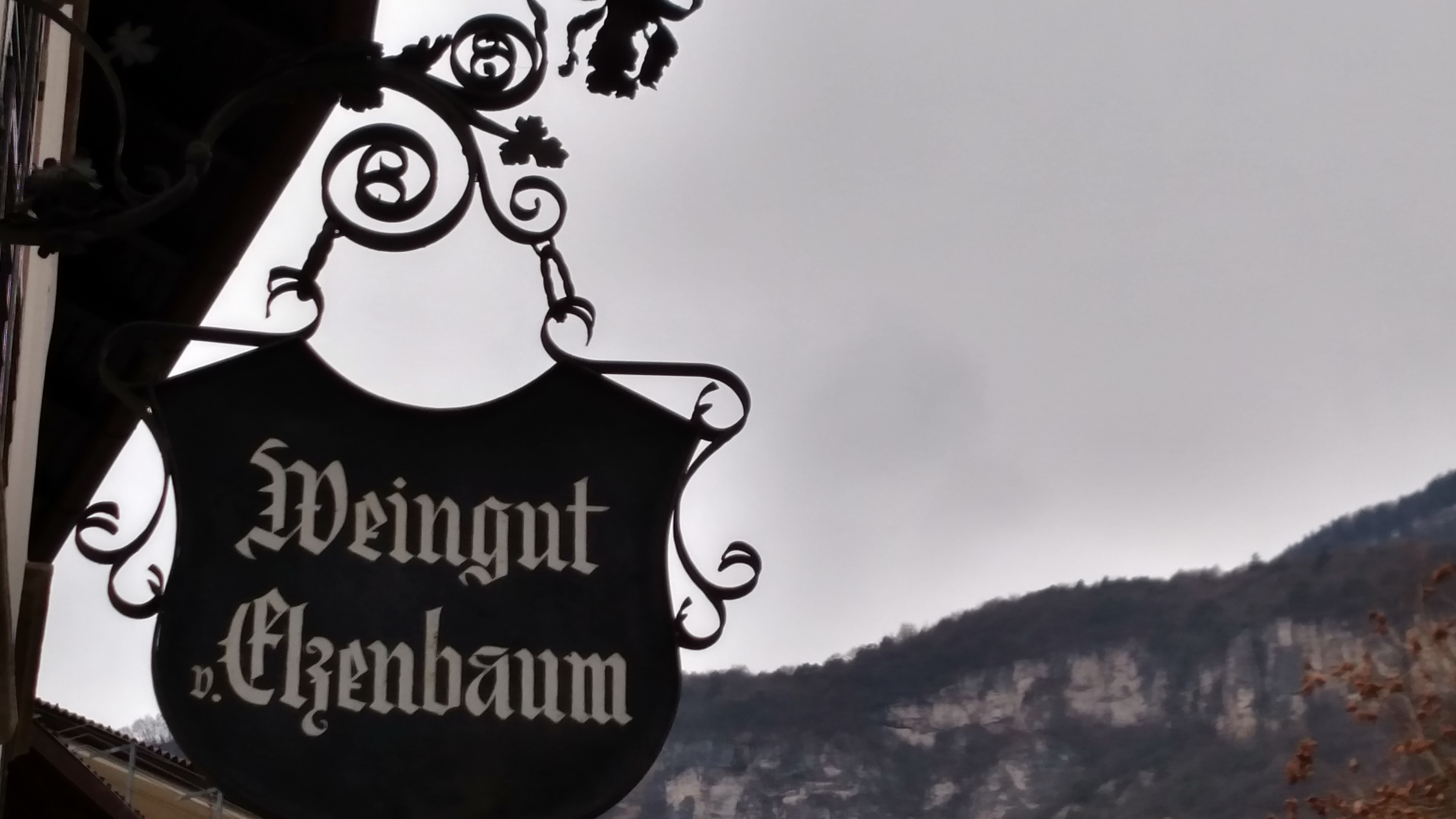
At Weingut von Elzenbaum, one of the town’s oldest family-operated cellars, Josef von Elzenbaum and Kaufmann Erich have teamed up as grower and winemaker to craft such regional specialties for the past three decades. A weingut refers to a winery where the grapes are harvested from vineyards owned or rented directly by the producer. Across the square from Weingut von Elzenbaum is another family legacy, J. Hofstätter.
The modest wood and iron signpost for Elzenbaum hangs over a small side street off the main platz, or piazza. The family business stretches back to the 19th century, with awards dating to 1886.
As the modern caretaker for Elzenbaum, Josef began learning his trade as a teenager, working with his father, Anton, after school. Anton doubled on duties as both grower and winemaker. The family’s vineyards are planted on southwest-facing hills, and Josef also grows apples on the valley floor.
An impressive polyglot, the white-tufted Josef speaks German and Italian and can carry on a conversation in English as he studies the language.
Though he will accept grazie, the proper thank you in Tramin, he’ll note with a grin, is a hearty danke.
 Chasing Wine